Choosing a guard hut UK businesses actually need at a site entrance depends mainly on visibility requirements and how many access points need monitoring at once — a single-window hut suits a simple checkpoint, while a multi-window gatehouse suits busier or multi-lane entrances. Here’s how to tell which one fits your site.
Table of Contents
<a name=”what-is”></a>
1. What a guard hut is for
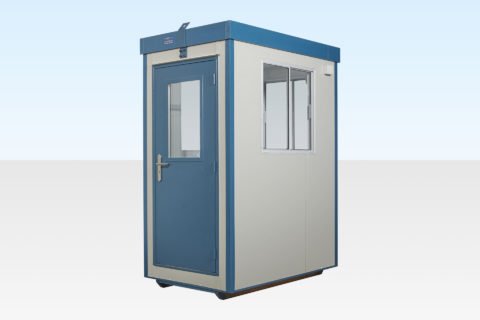
A guard hut UK site uses is a compact, secure cabin positioned at an access point to allow security or reception staff to monitor and control entry — common on construction sites, industrial yards, business parks, and event sites. Unlike a general-purpose site cabin, guard huts are designed around visibility, with windows positioned specifically to give a clear line of sight over the access point being monitored.
<a name=”types”></a>
2. Guard hut UK types compared
Single guard huts
The most compact option, suited to a single-lane entrance or checkpoint with one member of staff. See our 6ft x 6ft single guard hut and single guard hut for sale.
Multi-window security gatehouses
For busier entrances or where staff need visibility across multiple directions or lanes, a multi-window gatehouse gives wider sightlines than a standard single guard hut. See our 3-window security gatehouse.
<a name=”choosing”></a>
3. Choosing the right unit
Consider the number of access lanes, expected staff numbers per shift, and how much equipment (screens, radios, sign-in systems) needs to fit inside alongside the guard. For sites with a single, straightforward entrance, a standard single guard hut UK unit is usually sufficient and more cost-effective; multi-lane or high-traffic sites generally justify the wider visibility a gatehouse provides.
<a name=”faq”></a>
Guard hut UK: checklist before you buy
Before you order a guard hut UK sites will rely on, decide where it will stand and who will use it. A guard hut needs clear sightlines to the gate or barrier, a firm level base and, in most cases, a power supply for lighting, heating and any CCTV or access-control equipment. Think about the size of the team: a single-person hut is fine for a gatehouse, but shift changes, a kettle and a desk can quickly use up the space.
If the hut will be permanent, check planning requirements with your local authority; the Planning Portal explains the basics. Ask the supplier about door and window security, insulation and delivery, and compare specifications rather than headline prices. A well-chosen guard hut UK businesses can rely on year after year should be secure, warm in winter and easy to maintain.
Finally, consider whether you need a standard cabin or an anti-vandal model. Anti-vandal guard huts typically use reinforced windows and heavy-duty locks, which suits unattended or high-risk locations.
4. Frequently asked questions
Does a guard hut UK unit need mains power? Most guard huts are wired for mains power to run lighting, heating, and any monitoring equipment, though off-grid options can be arranged if a site lacks a mains connection.
Can a guard hut be relocated once installed? Yes — like most site cabins, guard huts are designed to be repositioned by a HIAB or similar delivery vehicle if the entrance point changes during a project.
What’s the difference between a guard hut and a standard site cabin? A guard hut is purpose-built around visibility and access monitoring, with windows positioned for sightlines over an entrance, whereas a standard cabin is designed for general office or storage use.
Related guides and products
Keep reading:
- Site welfare unit regulations
- Planning permission for containers
- Container modifications and custom builds
Shop the range:
2 Responses